
Bus Rapid Transit & Transit Safety
November 25, 2026 · 11:30 AM PT
#researchcollection#busrapidtransit#transitsafety#railsafety#transitsecurity
A research collection of 123 documents on bus rapid transit, bus and rail safety, accident investigation, transit security and rail rules, with notes on what has changed since the older ones were written.
Research collection: 123 documents on bus rapid transit, bus and rail safety, accident investigation, transit security and rail rules. Many are historical, and the study collection marks each one with its year.
Last updated November 25, 2026.
Overview
This collection brings together the planning guides, engineering studies, safety reports and legal material on bus and rail transit held in the research library. It starts with bus rapid transit (BRT): what it is, how agencies decide whether to build it, and how it is designed and run. It then widens to bus safety, rail accident investigation, transit security and the rules that govern passenger rail. Every document is listed by topic in the Transit Research Study Collection.
What BRT Is
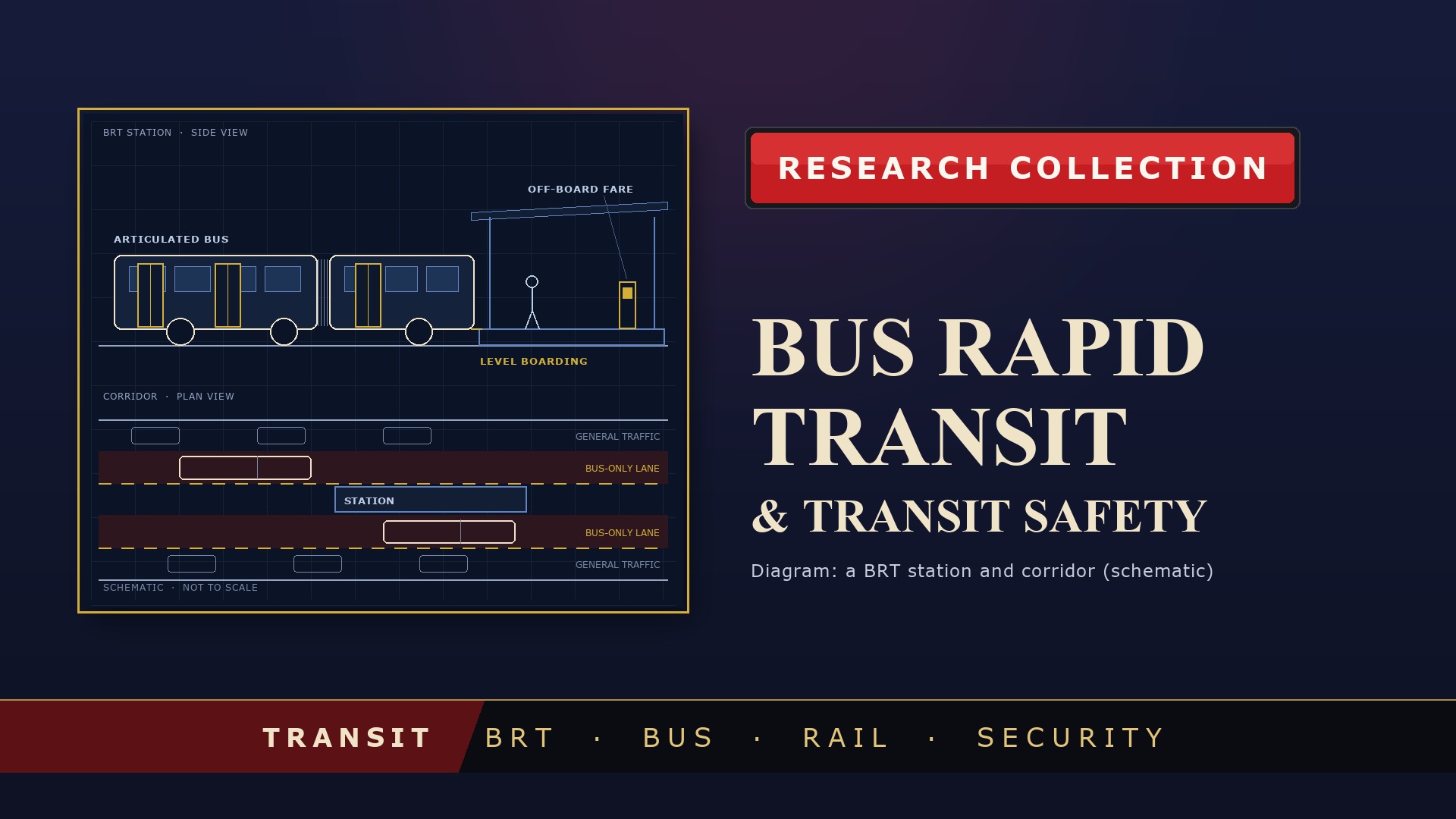
The Transit Cooperative Research Program's Bus Rapid Transit Practitioner's Guide (TCRP Report 118, 2007) describes BRT as "an integrated system of facilities, equipment, services, and amenities that improves the speed, reliability, and identity of bus transit." It adds that BRT "is, in many respects, rubber-tired light rail transit (LRT) with greater operating flexibility and potentially lower costs." The American Public Transportation Association's 2010 recommended practice on operating BRT puts it more briefly: "a suite of elements that create a high-quality rapid transit experience using rubber-tired vehicles."
Most guides list the same elements: running ways (bus lanes or separate busways), stations rather than simple stops, vehicles built for fast boarding, fares paid before boarding, technology such as transit signal priority and real-time information, frequent all-day service, and a distinct brand.
| Ordinary bus service | Bus rapid transit | Light rail | |
|---|---|---|---|
| Vehicle | Standard bus | Bus, often articulated and branded | Electric rail car on fixed track |
| Right of way | Mixed traffic | Bus lanes or separate busways for much of the route | Mostly separate track, some street running |
| Stops | Frequent kerbside stops | Fewer, larger stations, often with level or near-level boarding | Stations with level or near-level boarding |
| Fares | Usually paid on board | Often paid before boarding | Usually paid before boarding |
| Flexibility | Routes easy to change | Buses can leave the busway to serve other streets | Limited to the track |
| Cost to build | Low | Medium | Highest of the three |
U.S. federal law draws its own line. For Capital Investment Grants, 49 U.S.C. 5302 separates "fixed guideway" BRT, where most of the project runs in a separated right of way for transit during peak periods, from "corridor-based" BRT, which does not.
Planning and Decision-Making
The Federal Transit Administration's guides are the place to start. Its 2004 Characteristics of Bus Rapid Transit for Decision-Making describes each BRT element, what it costs and what performance it buys; the FTA replaced it with an updated edition in 2009. Earlier FTA work looked at the kinds of bus suited to BRT (2001). A 2012 report collected lessons agencies passed to one another on BRT and bus priority, and a 2016 demonstration tested automated steering and precision docking on buses in revenue service.
The FTA also sponsored two practitioner's guides through the Transportation Research Board: TCRP Report 90 (2003) and its successor, TCRP Report 118 (2007). Beyond federal work, the collection has the Institute for Transportation and Development Policy's planning guide, case studies prepared for Lane Transit District in Oregon and for Montgomery County, Maryland, San Francisco's study of a "rail-ready" Geary Boulevard BRT, and international reviews by Robert Cervero and by Alexandros Nikitas and MariAnne Karlsson.
Safety and Accident Investigation
Buses. The collection has guidance on locating and designing safe bus stops, a crash-simulation study of how passengers are hurt when a bus is struck, lessons from compressed-natural-gas bus fires in France and Germany, and APTA's maintenance practices for bus air brakes.
Rail. For investigation methods there is a forensic framework for accidents on trains run by wireless train control, and the SAFE-Net accident model. APTA's standard for notifying and investigating rail transit accidents is here in its 2018 revision. On derailments, there are statistical work on their causes, Dan Brabie's two theses on limiting harm after a train leaves the track, wheel-climb criteria for transit, and an emergency-response case study of an ethanol unit-train derailment. Two studies look at trains running through switches in yards, and the National Institute of Standards and Technology tested the fire behaviour of passenger car materials.
Transit Security
Brian Michael Jenkins's work for the Mineta Transportation Institute frames the subject. His 1997 report on protecting surface transportation from terrorism was followed in 2018 by Train Wrecks and Track Attacks, a worldwide chronology of attempts to derail trains. A 2016 Naval Postgraduate School thesis looks at how to spend rail security money where the risk is highest, and the GAO reviewed rail security after September 11.
Security on buses and at stops is a different problem: everyday crime and harassment more than terrorism. The collection has a Los Angeles study of bus-stop crime "hot spots", a pilot on women's safety on buses in Bhopal, a journal foreword on women's safety in transit, and an Oak Ridge study of technologies that help older, disabled and low-income riders.
Rail Rules and Passenger Rail
The federal operating rules for railroads are in 49 CFR Part 218; the collection has the 2012 edition. Legal material covers federal pre-emption, claims against railroads, a Ninth Circuit derailment appeal, rail labour law and two Amtrak union agreements.
On passenger rail, the Federal Railroad Administration studied how Amtrak could account for everyone on board after an accident. That question links this collection to the Sunset Limited derailment (1995), the unsolved sabotage of an Amtrak train in Arizona. This collection adds Arizona's rail plan and safety guide and a history of Arizona's railroads. It also holds a business-school case study of Amtrak's response to an earlier wreck of the same train, the other Sunset Limited disaster at Big Bayou Canot (1993). See also the Sunset Limited study collection.
What's Changed Since
Many of these documents have newer editions, or have been overtaken by new federal rules. The FTA's 2004 decision-making guide has a 2009 update. The capacity manual is now in its fourth edition (2026). The FTA rewrote its noise and vibration manual in 2018. APTA revised its rail accident notification standard in 2025, after federal rules moved to two-hour notification. Since 2020, the TSA has required security training for many transit and rail workers. The study collection pairs each older document with its replacement and links the official source.
Key Sources
| Document | Link |
|---|---|
| Bus Rapid Transit Practitioner's Guide (TCRP Report 118), Transit Cooperative Research Program (2007). Historical. The standard U.S. guide to BRT: its elements, costs, ridership and land-use effects. | Publisher ↗ |
| Characteristics of Bus Rapid Transit for Decision-Making, Federal Transit Administration (2004). Historical. The FTA's decision-making guide to each BRT element and the performance it buys. An updated edition followed in 2009. | Library → |
| Operating a Bus Rapid Transit System (APTA BTS-BRT-RP-007-10), American Public Transportation Association (2010). Historical. APTA's recommended practice for running BRT, and the source of its definition. | Publisher ↗ |
| Vehicle Assist and Automation (VAA) Demonstration Evaluation Report (FTA Report 0093), Rob Gregg & Brian Pessaro, National BRT Institute, for the FTA (2016). The FTA's demonstration of automated steering and precision docking on BRT buses. | Library → |
| Rail Transit Accident/Incident Notification and Investigation Requirements (APTA RT-OP-S-002-02 Rev 3), American Public Transportation Association (2018). APTA's standard for reporting and investigating rail transit accidents, since revised. | Publisher ↗ |
| Train Wrecks and Track Attacks: Attempts by Terrorists and Other Extremists to Derail Trains or Disrupt Rail Transportation, Brian Michael Jenkins & Bruce R. Butterworth, Mineta Transportation Institute (2018). A worldwide chronology of attempts to derail trains, including the Sunset Limited. | Library → |
| Why Do Passenger Trains Run through Switches in the Rail Yard? (DOT/FRA/ORD-19/37), Federal Railroad Administration (2019). A human-factors study of why passenger trains run through switches in yards. | Library → |
| Evaluation of Options for Improving Amtrak's Passenger Accountability System (DOT/FRA/ORD-05/06), Federal Railroad Administration (2005). Historical. How Amtrak could know who was on board after an accident. | Library → |