
Sunset Limited Derailment (1995)
November 11, 2026 · 4:00 PM PT
#sunsetlimited#amtrak#trainderailment#sabotage#arizona#coldcase
The unsolved 1995 sabotage of Amtrak's Sunset Limited in the Arizona desert, which killed one Amtrak employee and injured more than 100 people, told through FBI releases and the federal court record.
Overview
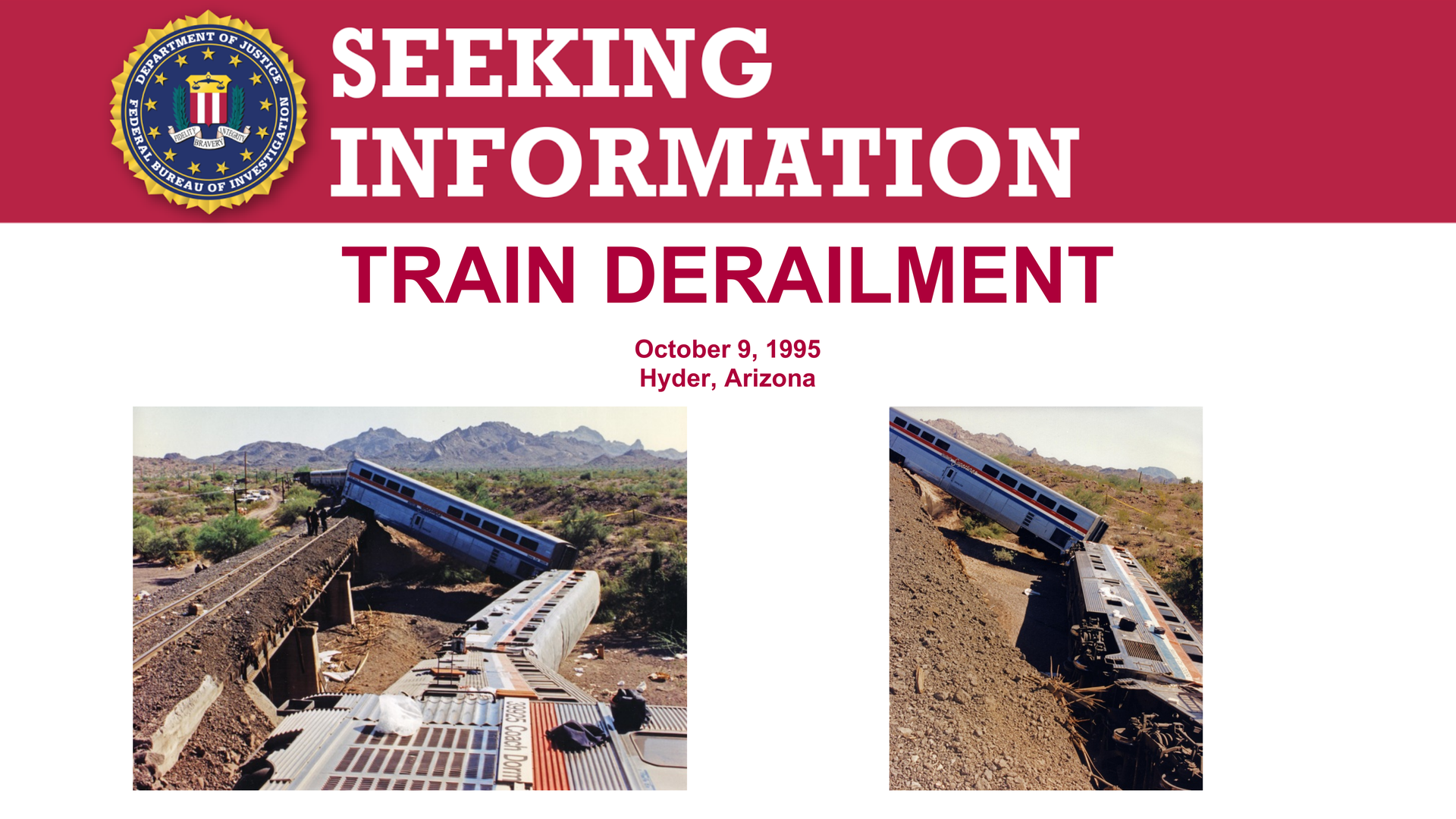
On October 9, 1995, Amtrak's Sunset Limited derailed while crossing a bridge in a remote desert area about 70 miles southwest of Phoenix, Arizona, near Hyder. The train was traveling from El Paso to Los Angeles with 258 passengers on board. One Amtrak employee was killed, 12 people were seriously injured and about 100 more had minor injuries.
The derailment was deliberate. Someone had removed the bolts and spikes holding one rail in place and taken out the two angle bars that joined the rails. They also rewired the track's electric warning circuit so the signal still showed green, and the crew had no warning. Investigators at the scene found a note claiming responsibility and expressing anti-government sentiment. No one has been arrested.
The FBI continues to investigate, jointly with the Amtrak Police Department, the Maricopa County Attorney's Office and the United States Attorney's Office for the District of Arizona. A reward of up to 310,000 dollars is offered for information leading to an arrest and conviction.
This hub gathers the official record of the case and the research shelf built around it.
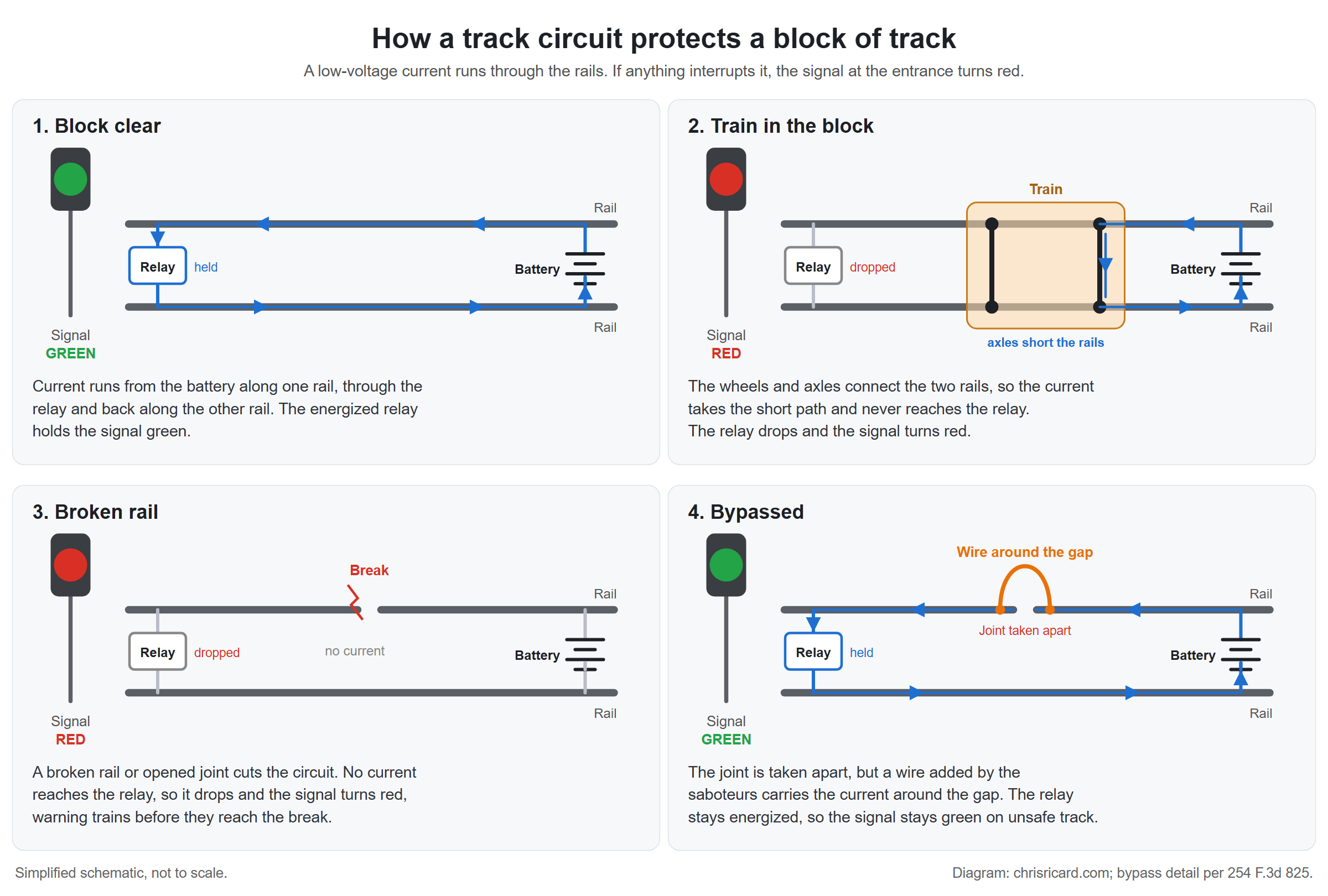
On this line the track circuits fed trackside signals only; there were no signals in the locomotive cab. A dispatcher governed train movements through Direct Traffic Control, supplemented by those signals. Post-incident shunt tests found the signals had worked as designed. (MTI Report 97-04, p. 30.)
Timeline
- Week before the derailment: A qualified track inspector checked the track near the derailment site twice, as Federal Railroad Administration rules required, and a tie plate nearby was replaced on October 5, 1995. The federal appeals court later found no evidence of any defect in the track before the sabotage.
- October 9, 1995, about 1:23–1:35 a.m.: The Sunset Limited derailed near Milepost 846.86 on track then owned and maintained by Southern Pacific. The court record gives about 1:23 a.m. MST; the FBI gives about 1:35 a.m. The train was moving at about 50 miles per hour, a safe speed for that place, and its crew had passed a green signal about 1.5 miles earlier. Both locomotives and 8 of the 12 cars left the track, and the train went off the bridge into a ravine.
- Investigators found several typewritten copies of a note near the train, signed ‘Sons of the Gestapo’ and referring to the government siege at Waco. Officials said they did not know whether it was a ruse. (The New York Times, October 14, 1995.)
- Investigation: By March 1996, the investigation was being run from a command center at the FBI’s Phoenix office, staffed by the FBI, Amtrak police, Southern Pacific police and the Maricopa County Sheriff’s Department. (Mineta Transportation Institute symposium report, 1996, p. 35.)
- After the derailment: Rescuers struggled to reach the remote site. Makeshift roads were built, and rescue teams traveled in convoys so they would not get lost. Investigators at the scene found the note claiming responsibility.
- 1997: Injured passengers sued Amtrak and the railroads in federal court in Arizona (case CV 97-02038), claiming the crew and railroads were negligent.
- District court ruling: Judge Robert C. Broomfield granted summary judgment to the defendants, holding that the saboteurs' criminal act was an unforeseeable intervening cause of the wreck.
- June 18, 2001: The Ninth Circuit affirmed in Guidroz-Brault v. Missouri Pacific Railroad Co. It found no proof that any sign of the sabotage was visible to the crew in time to stop, noting that the saboteurs had taken deliberate pains to conceal their work.
- April 10, 2015: The FBI Phoenix Field Office announced a combined reward of up to 310,000 dollars: up to 250,000 dollars from the FBI, up to 50,000 dollars from Amtrak and up to 10,000 dollars from the Maricopa County Attorney's Office.
- October 9, 2020: On the 25th anniversary, the FBI said the reward still stands and that investigators are reexamining evidence with new technology and following up public tips.
What the 1997 MTI Case Study Found
Mineta Transportation Institute Report 97-04 (December 1997), by Brian Michael Jenkins, includes a case study of the wreck, "The Derailment of Sunset Limited," by James Graebner of the Lombardo Group (pp. 23–32). Its main findings:
- The site was chosen for maximum harm. The saboteurs picked a 30-foot-high trestle about 18 miles from a paved road, a place that seemed chosen to do the most damage, avoid discovery and slow down rescuers (p. 26).
- The train held together. Both locomotives and 8 of the 12 cars derailed, but their basic structure stayed intact. "The cars did not telescope," and the passenger space was generally not crushed. Both locomotives stayed upright, and their cabs did not cave in on the crew (pp. 26, 29).
- No fire. There was no fire from spilled fuel and no release of toxic gases (pp. 26, 29).
- Design got the credit. Graebner concludes that the rolling stock's safety features "probably played a key role in minimizing death and injury to passengers and crew" (pp. 29–30).
- Passengers helped themselves. Passengers opened the emergency window hatches and began rescuing one another within minutes.
The study doesn't specifically mention couplers. It also notes that FRA inspectors and an NTSB investigation team went to the scene (p. 28). Some of its figures differ from the FBI's; for example, it counts 65 injured.
Key Documents
- FBI Phoenix press release, April 10, 2015: announces the 310,000-dollar reward and gives the FBI's official account of the deaths, injuries and passenger count. FBI.gov (archived copy)
- FBI Phoenix press release, October 9, 2020: the 25th-anniversary appeal, confirming that the case is open and the reward still stands. FBI.gov (archived copy)
- FBI story "Train Derailment Mystery," October 9, 2020: an FBI task force investigator describes the crash, the rescue and the anti-government note. FBI.gov (archived copy)
- FBI "Seeking Information" poster, Train Derailment, October 9, 1995, Hyder, Arizona: offers up to 250,000 dollars from the FBI and shows two photographs of the wreck. It is no longer on FBI.gov; the copy here is an archived version. PDF (archived original)
- Guidroz-Brault v. Missouri Pacific Railroad Co., 254 F.3d 825 (9th Cir. 2001): the federal appeals decision in the passengers' lawsuit. It sets out the undisputed physical evidence of the sabotage. PDF
- Senate Hearing 107-311, "Riding the Rails: How Secure Is Our Passenger and Transit Infrastructure?" (December 13, 2001): a Senate Governmental Affairs Committee hearing after September 11 in which the chairman cites the Sunset Limited sabotage as an example of terrorism against rail. govinfo.gov
Research Papers
| Source | Link |
|---|---|
| Brian Michael Jenkins, Protecting Surface Transportation Systems and Patrons from Terrorist Activities, MTI Report 97-04 (Mineta Transportation Institute, December 1997) | PDF ↗ |
| Dan Brabie, On the Influence of Rail Vehicle Parameters on the Derailment Process and Its Consequences, licentiate thesis, TRITA AVE 2005:17 (KTH Royal Institute of Technology, 2005) | PDF ↗ |
| Federal Railroad Administration, Why Do Passenger Trains Run Through Switches in the Rail Yard?, DOT/FRA/ORD-19/37 (2019) | Read ↗ |
| Federal Railroad Administration, Understanding How Train Dispatchers Manage and Control Trains: Results of a Cognitive Task Analysis, DOT/FRA/ORD-01/02 (2001) | Read ↗ |
| Federal Railroad Administration, Railroad Dispatcher Communications Training Materials, DOT/FRA/ORD-03/12 (2003) | Read ↗ |
| Shih et al., "Understanding the Impact of Train Run-Throughs on Railway Switches Using Finite Element Analysis," Proceedings of the IMechE, Part F (2018) | Read ↗ |
| Bemment et al., "Improving the Reliability and Availability of Railway Track Switching by Analysing Historical Failure Data and Introducing Functionally Redundant Subsystems," Proceedings of the IMechE, Part F 232(5) (2018) | Read ↗ |
| Lawrence W. King, Improving Resource Allocation Decisions to Reduce the Risk of Terrorist Attacks on Passenger Rail Systems, master's thesis (Naval Postgraduate School, December 2016) | Read ↗ |
| National Archives, Records Relating to North American Railroads, Reference Information Paper 91, compiled by David Pfeiffer (2001) | PDF ↗ |
Further Reading
The attack itself
Who does this and why
Warning signs and prevention
Rail security and passenger safety
Arizona context
Derailment engineering
Archives and research resources
- Southern Pacific Railroad Company Records, 1895-1991 (Stanford University Libraries, Special Collections, M1010). Finding aid for the railroad's corporate records, which end in 1991, before the derailment.
If you have information about the derailment, the FBI asks you to contact its Phoenix Field Office at 623-466-1999 or submit a tip at tips.fbi.gov.
Note: Archived pages open in the Wayback Machine. Use your browser’s Back button to return here.
- Train Derailment - FBI Seeking Information Poster (Sunset Limited, 1995)
- Guidroz-Brault v. Missouri Pacific Railroad Co., 254 F.3d 825 (9th Cir. 2001)