
Introduction and Overview to Track Circuits (Course 101 Participant Guide Preview)
November 11, 2026 · 2:34 PM PT
#trackcircuits#signals#railsafety#training#derailment
A preview of a signals training course guide explaining how track circuits detect trains and broken rails, and why a break in the circuit is meant to turn the signal to stop.
Overview
This document is a 13-page preview of the participant guide for Course 101, "Introduction and Overview to Track Circuits," from the Signals Maintenance Training Consortium, a voluntary training partnership of transit agencies and labor unions supported by the Transportation Learning Center. The pages are marked as a training draft for consortium use only and not for distribution, so this post summarizes it and does not attach it. The course introduces new signal maintainers to train detection and rail structure, using photographs and diagrams supplied by transit agencies and Amtrak.
The guide explains that a track circuit is a simple series electrical circuit in which the running rails form part of the path. A power source such as a transformer at the "feed end" sends current through the rails to a track relay at the "relay end." While current reaches the relay it stays energized, and the circuit reads as unoccupied. When a train enters, its wheels and axles shunt the current away from the relay, the relay drops and an "occupied" condition goes to the wayside signal, which shows stop for that block. In the same way, a broken rail or a missing track component opens the circuit, the relay loses current and the signal goes to its restrictive state. The guide stresses that track circuits are fail-safe: any equipment failure or break in the rail or circuit is "designed to fail in the most restrictive state possible."
The guide also describes rail bonds, copper wires welded to the rail head that carry the circuit across rail joints, and notes that missing or damaged bonds affect the integrity of the circuit. It lists "bootleg" connections to the rail among its key terms and warns that in real track there can be "sneak" paths around a break in the return rail. Because these circuits detect a break only through loss of current, the guide's own principles show why someone who keeps current flowing around a gap could stop the circuit from seeing it. In the Sunset Limited case, the Ninth Circuit later described saboteurs rewiring the track's warning system so the block signal kept showing green after the joining bars were removed; that detail comes from the court's opinion, not from this guide.
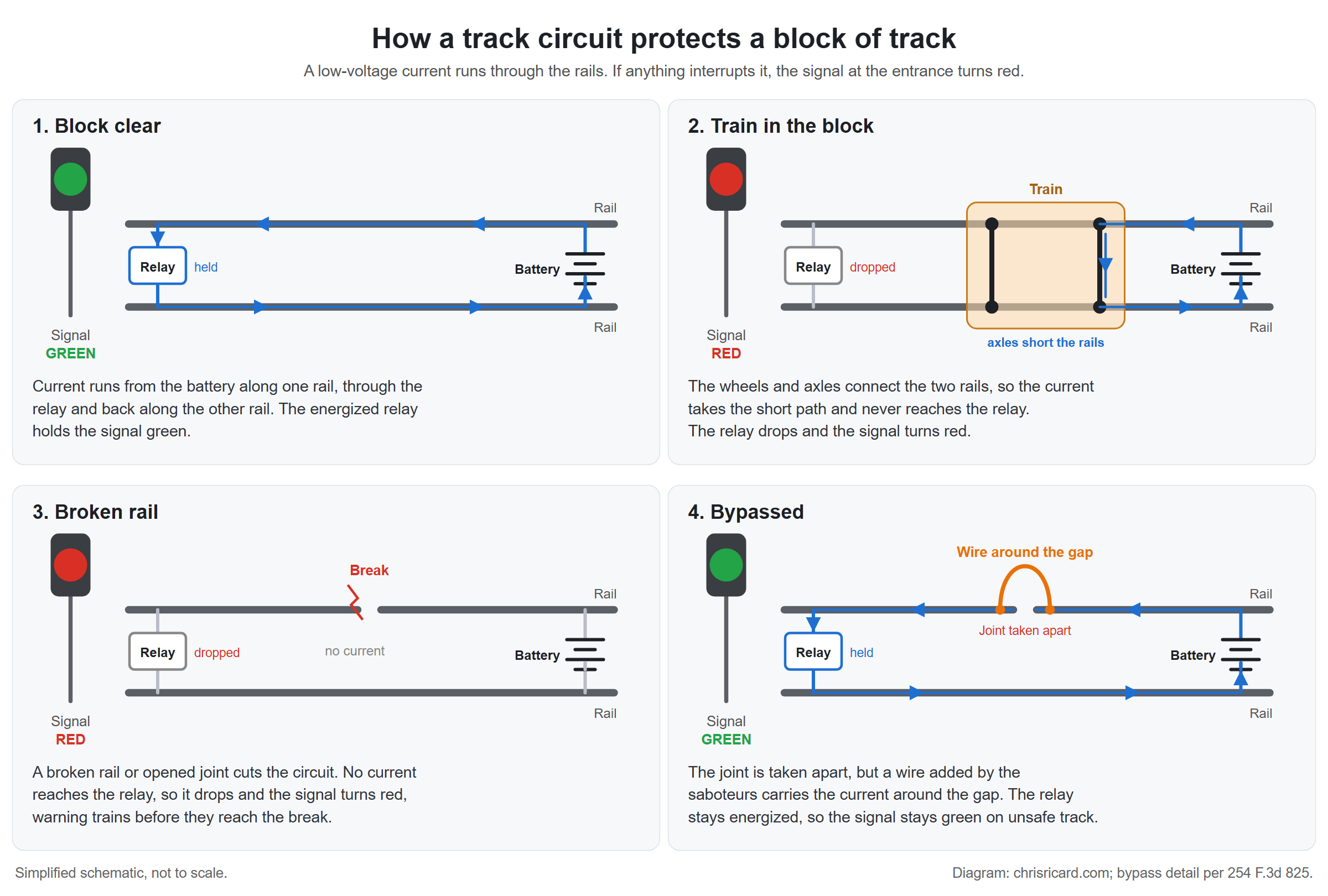
On this line the track circuits fed trackside signals only; there were no signals in the locomotive cab. A dispatcher governed train movements through Direct Traffic Control, supplemented by those signals. Post-incident shunt tests found the signals had worked as designed. (MTI Report 97-04, p. 30.)
Key Points
- The guide says track circuits are the most common way to detect both trains and broken rails.
- Nearly all track circuits work by sensing a loss of transmitted energy, whether caused by train wheels or a broken rail.
- A track circuit is not the same as a block: a block is a defined length of track that may contain several circuits, with movement governed by block or cab signals.
- Circuits are separated by insulated joints, impedance bonds or tuned receivers, and come in DC, AC, audio frequency, coded and microprocessor-based types.
- Rail bonds keep current flowing across joints, and the guide warns that missing or broken bonds compromise the circuit.
Citation
Signals Maintenance Training Consortium and Transportation Learning Center. "Introduction and Overview to Track Circuits," Course 101 Participant Guide (training draft, preview pages). Marked for Signals Training Consortium use only.