
Deepwater Horizon (Gulf of Mexico, 2010)
November 25, 2026 · 8:11 AM PT
#deepwaterhorizon#macondo#bpoilspill#blowoutpreventer#offshoredrilling
On 20 April 2010 the Macondo well blew out beneath the Deepwater Horizon rig in the Gulf of Mexico, killing 11 workers and starting an 87-day oil spill. This page sets out what the official investigations found about the cement job, the blowout preventer and the decisions behind them, where those reports differ, and the legal outcomes.
Status: Investigated and settled. The well was permanently sealed on 19 September 2010. Four official investigations and a forensic examination of the blowout preventer reported between 2011 and 2016. BP, Transocean and Halliburton pleaded guilty to federal crimes in 2013, and BP's civil settlement with the United States and the five Gulf states was entered by the court in April 2016. Restoration projects paid for by that settlement are still under way.
Last updated November 25, 2026. This page sticks to what the official reports found; where they differ, it says so.
What Happened
At about 9:50 p.m. on 20 April 2010, the Macondo exploratory well blew out under the Deepwater Horizon, a drilling rig owned by Transocean and leased to BP. The rig was working in Mississippi Canyon Block 252, about 50 miles off the Louisiana coast, in roughly 5,000 feet of water. The crew was finishing "temporary abandonment" work to secure the well before the rig moved on.
- An influx of hydrocarbons (a "kick") went undetected and escalated to a blowout.
- Gas that flowed onto the rig floor through a mud-gas vent line ignited in two explosions.
- Eleven workers were killed and 17 were injured.
- The fire burned until the rig sank on 22 April.
- Oil flowed from the well for 87 days, until it was capped on 15 July 2010. A relief well permanently sealed it on 19 September 2010.
The government's estimate of the total spilled was about 4.9 million barrels. In 2015 the federal court found, for the purpose of the Clean Water Act penalty, that 3.19 million barrels were discharged once the oil BP collected was subtracted. The two figures were made for different purposes and are both on the record.
The Well and the Cement Job
Every investigation found that the blowout started with a failed barrier at the bottom of the well.
- The cement. BOEMRE's investigators found that a central cause was failure of the cement barrier in the production casing, the steel pipe set in the well to keep it sealed. They could not say exactly why it failed, but named three likely reasons: cement and drilling mud swapping places in the bottom section of casing, contamination of that cement, or pumping the cement past its target so little or none was left there. The Commission's Chief Counsel reached the same core finding: the cement BP and Halliburton pumped "did not seal off hydrocarbons in the formation."
- One barrier. BOEMRE found that BP set only one cement barrier, and that BP made a series of last-minute decisions that added risk to the cement job.
- The negative-pressure test. This test checks whether the bottom of the well is sealed. The Commission found that it was "conducted and interpreted improperly," and that the misreading was a major contributor to the blowout. No regulation at the time required the test or set a procedure for it.
- Missed warning signs. In the last hour, pressure readings showed the well was flowing. The Commission found the crew should have done a flow check and shut in the well as soon as flow was confirmed.
The Commission concluded that the blowout "could have been prevented" and that its root causes were "systemic": failures of management at BP, Halliburton and Transocean, and failures of government regulation.
The Blowout Preventer
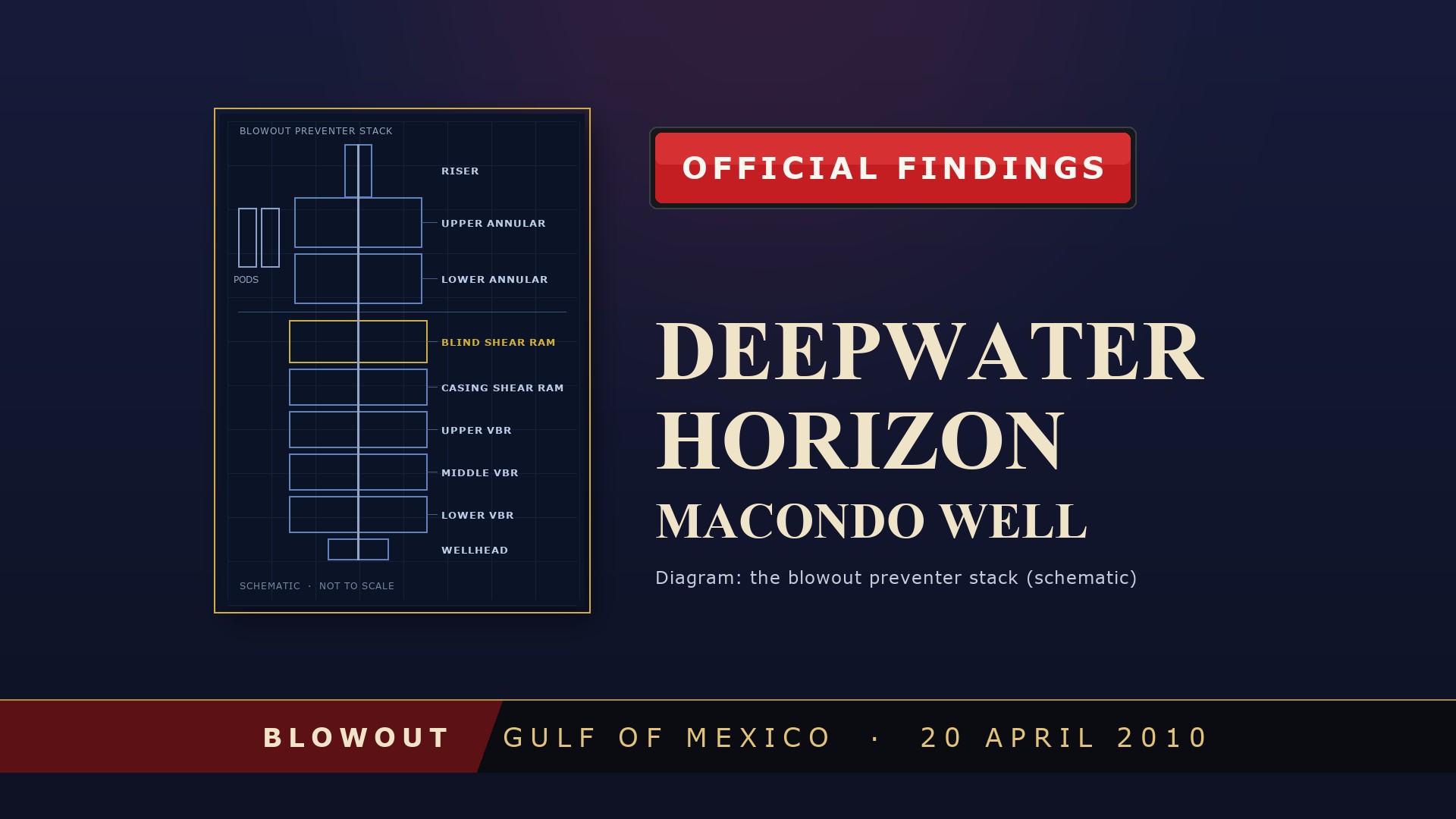
What it is. A blowout preventer (BOP) is a stack of valves on the wellhead at the seabed, designed to seal the well if control is lost. The Deepwater Horizon's stack was built by Cameron and had been in use since the rig was commissioned in 2001. DNV's forensic report describes it as two parts:
- Upper section (the lower marine riser package): two annular preventers, rubber seals that close around the pipe, and two control pods, called yellow and blue, that turn signals from the rig into hydraulic action.
- Lower stack: five sets of rams. These are the blind shear rams, which are meant to cut the drill pipe and seal the well, the casing shear rams, and three variable-bore rams that close around the pipe.
The stack also had an emergency system, the automatic mode function (AMF) or "deadman." It is meant to close the blind shear rams by itself if the rig loses power and hydraulics.
What failed. All the investigations agree that the blind shear rams closed but did not seal the well. DNV examined the recovered stack in 2010–2011 and found that a section of drill pipe was off centre, partly outside the cutting blades. It became trapped between the ram blocks and kept them from closing fully. Both DNV and the CSB found that the pipe had buckled inside the stack, pushing it toward the side of the wellbore.
Where the reports differ.
- Why the pipe buckled. DNV (2011) found that forces from the flowing well during the blowout most likely buckled the pipe. The CSB (2014) found that the cause was "effective compression," the result of large pressure differences between the inside and outside of the pipe. The CSB added that this can happen even after a crew has first sealed a well.
- The emergency system. The CSB found that only one of the two control pods worked that day. The blue pod was miswired, which drained a critical battery. A key valve in the yellow pod had also been miswired. Even so, the CSB concluded that the deadman system "most likely functioned," but the buckled pipe stopped the rams from sealing.
- Timing. The Commission and its Chief Counsel reported before DNV finished, so they offered no final conclusions on the BOP. The Chief Counsel noted that the explosions, the fire and the 11 deaths would have happened whatever the state of the BOP, because gas reached the rig first.
Testing and pre-check questions. The CSB found that at the time, neither U.S. regulations nor recommended industry practice required anyone to test the deadman system. It also found that no testing or monitoring was in place to confirm that the backup systems were actually available. The CSB warned in 2016 that, even with the testing changes made after the disaster, faults like those found on the Deepwater Horizon's BOP "could still remain undetected" in BOPs in use. The official findings raise these questions for any pre-check:
- Are both control pods working, and are their batteries charged and their solenoid valves wired correctly?
- Has the deadman system been tested with the stack on the wellhead, not only on deck before it was lowered?
- Can the shear rams cut and seal on the pipe in the hole, including pipe that is off centre or under compression?
- Is anyone monitoring whether the backup systems stay available between tests?
An example: BP's post-blowout BOP testing memo. This is a BP internal file note, not a checklist form. It is titled Enhanced Subsea Blow out Preventer (BOP) Stack Testing for Dynamically Positioned Rigs in the Gulf of Mexico, and it was signed by BP's Vice President of Engineering, Drilling and Completions on 27 April 2010, a week after the blowout. It is specific to BP's dynamically positioned rigs in the Gulf after Deepwater Horizon, not a general industry or regulatory form. The House Energy and Commerce Committee made it public in May 2010.
- What it records: MMS rules required BOP stacks to be stump tested at the surface, pressure tested once installed on the well and then every 14 days, but did not require the emergency systems to be tested once the stack was on the seabed.
- The emergency systems it lists: the deadman, the autoshear, the emergency disconnect system and ROV intervention, all normally tested only on deck before the stack was lowered.
- What it proposes: testing the deadman and ROV intervention ram-closure systems once the stack is installed subsea, on BP-operated dynamically positioned rigs in the Gulf.
- The question it raises: with no way to see the rams on the seabed, how do you know the systems worked? The memo's answer is to watch for control fluid venting by ROV and to count the fluid needed to reopen the rams.
The Investigations and Their Findings
| Investigation | Published | Main findings |
|---|---|---|
| National Commission on the BP Deepwater Horizon Oil Spill and Offshore Drilling, Deep Water | January 2011 | The disaster could have been prevented; mistakes by BP, Halliburton and Transocean revealed systematic failures in risk management; root causes were systemic, in industry and in government regulation. |
| Commission Chief Counsel's report, Macondo: The Gulf Oil Disaster | 2011 | Detailed technical account; the cement failed to seal off the hydrocarbons; no final conclusions on the BOP before DNV's analysis. |
| DNV, Forensic Examination of the Deepwater Horizon Blowout Preventer, for BOEMRE | 20 March 2011 (addendum 30 April 2011) | Blind shear rams failed to seal because drill pipe, buckled by forces during the loss of well control, was trapped between the ram blocks. |
| Joint Investigation Team, Volume I (U.S. Coast Guard) | 2011 | The rig's safety systems and crew emergency response, including the explosions, fire, sinking and loss of 11 crew members. |
| Joint Investigation Team, Volume II (BOEMRE) | 14 September 2011 | A central cause was failure of the production casing cement; BP, as operator, was ultimately responsible for safe operations; Transocean and Halliburton also had responsibilities. |
| U.S. Chemical Safety Board, Macondo investigation, Volumes 1–4 | 2014–2016 | Volume 2: the deadman most likely fired but buckled pipe stopped the rams sealing; miswiring disabled one pod; no testing was required; safety-critical equipment needs better management. Later volumes cover human factors, organisations and regulation. |
Where the reports differ: DNV and the CSB give different causes for the pipe buckling (above); the government's 4.9 million barrel estimate differs from the court's 3.19 million barrel finding (above); and the earlier reports left the BOP failure open while DNV's work was pending.
Legal Outcomes and Settlements
- BP (criminal): pleaded guilty to 14 counts, including 11 felony counts of manslaughter, one felony count of obstruction of Congress, and Clean Water Act and Migratory Bird Treaty Act violations. In January 2013 it was sentenced to pay $4 billion in criminal fines and penalties (U.S. Department of Justice).
- Transocean: pleaded guilty to a Clean Water Act violation and agreed to pay $1.4 billion, $400 million of it criminal and $1 billion civil (U.S. Department of Justice, January 2013).
- Halliburton: pleaded guilty in 2013 to destroying evidence related to the disaster and was fined $200,000, the statutory maximum (U.S. Department of Justice).
- Fault (2014): on 4 September 2014 the federal court in New Orleans found that BP had acted with gross negligence, and assigned 67 percent of the fault to BP, 30 percent to Transocean and 3 percent to Halliburton.
- Oil volume (2015): on 15 January 2015 the court found that 3.19 million barrels had been discharged, for setting the maximum Clean Water Act penalty.
- BP civil settlement (2016): on 4 April 2016 the court entered the consent decree. It included a $5.5 billion Clean Water Act civil penalty and up to $8.8 billion for natural resource damages (U.S. EPA). The Justice Department valued the whole settlement at up to $20.8 billion.
Current Status
- Restoration: the natural resource damages money is paid in yearly instalments over 15 years and spent by state and federal trustees. Their 2025 annual reports, published in June 2026, list $3.34 billion invested in 384 restoration projects (Deepwater Horizon Trustees, NOAA).
- BOP testing: the CSB's 2016 warning about undetected BOP faults is the latest official finding on BOP testing in this collection.
- As of 25 November 2026: no new official investigation of the disaster has been reported.
In This Collection
Sources
| Source | Link |
|---|---|
| National Commission on the BP Deepwater Horizon Oil Spill and Offshore Drilling, Deep Water: The Gulf Oil Disaster and the Future of Offshore Drilling, January 2011 | Library → Read ↗ |
| National Commission, Macondo: The Gulf Oil Disaster, Chief Counsel's Report, 2011 | Library → Read ↗ Archive ↗ |
| DNV for BOEMRE, Forensic Examination of Deepwater Horizon Blowout Preventer, Volume I, 20 March 2011 | Library → Read ↗ |
| DNV for BOEMRE, Addendum to the final report, 30 April 2011 | Library → Read ↗ |
| U.S. Coast Guard, Joint Investigation Team report, Volume I, 2011 | Library → Read ↗ |
| BOEMRE, Joint Investigation Team report, Volume II, 14 September 2011 | Library → Read ↗ |
| U.S. Chemical Safety Board, Macondo investigation, Volume 2: BOP technical failure analysis, June 2014 | Library → Read ↗ |
| U.S. Chemical Safety Board, Macondo investigation, Executive Summary, April 2016 | Library → Read ↗ |
| BP internal file note, Enhanced Subsea BOP Stack Testing for Dynamically Positioned Rigs in the Gulf of Mexico, 27 April 2010, released by the House Energy and Commerce Committee | PDF ↗ |
| U.S. District Court, E.D. La., Phase Two findings on the quantity of oil discharged, 15 January 2015 | Library → Read ↗ |
| U.S. Department of Justice, BP pleads guilty and is sentenced to pay $4 billion, January 2013 | Read ↗ |
| U.S. Department of Justice, Transocean agrees to plead guilty and pay $1.4 billion, January 2013 | Read ↗ |
| U.S. Department of Justice, Halliburton pleads guilty to destruction of evidence, 2013 | Read ↗ |
| NPR, BP acted with gross negligence, federal judge rules, 4 September 2014 | Read ↗ |
| U.S. EPA, Deepwater Horizon: BP oil spill, enforcement and settlement | Read ↗ |
| JURIST, federal judge approves $20 billion Gulf oil spill settlement, 4 April 2016 | Read ↗ |
| Deepwater Horizon Trustees (NOAA), 2025 annual reports: $3.34 billion in 384 projects, June 2026 | Read ↗ |
Note: Archived pages open in the Wayback Machine. Use your browser’s Back button to return here.